
Regulatory and Card Network Compliance
Expert analysis of regulatory expectations and card network requirements to help organizations balance compliance expectations with growth goals.
Payment service providers must stay abreast of changing regulations and card network rules. LegitScript explains these requirements and helps organizations apply them to merchant onboarding and monitoring. With our insights, teams can reduce compliance gaps and improve risk management while scaling their business.
Major card brands regularly enforce compliance rules and issue assessments against payment service providers whose merchants fail to meet network standards — with fines that can be $100,000 or more per violation.
Blog Articles

Latest Blog Article
How LegitScript Protects Payment Processors From Tobacco Risk
August 13, 2026
by Erin Feebeck
LegitScript has launched two new reporting updates to keep client portfolios safe from merchants offering unauthorized tobacco products and illegal sales to minors. Keep reading to learn how we are helping payment processors and online platforms navigate this high-risk landscape.
Prediction Markets: The New Frontier of Financial and Gambling Risk
Prediction markets promise crowdsourced forecasting, but they’re pulling payment processors into a regulatory gray zone. The CFTC treats them as futures contracts. Several states call them gambling. That split leaves acquirers and ISOs exposed to compliance risk they didn’t sign up for. Keep reading to learn more about these merchants.
August 3, 2026
by Gabby Fisher
Card Networks Are on Notice: What Concerns About the ENDS Market Means for Payment Processors
A group of state attorneys general just told major card networks to stop processing for illegal vape sellers. Learn what the letter is asking card networks to do, and the exact questions banks, ISOs, and PSPs need to answer before regulators come knocking.
July 30, 2026
Guides

Smarter Onboarding for Payments Leaders
Is your merchant onboarding keeping up with rapidly changes to risk and competition? Learn how to future-proof your onboarding with our guide.
24 pages

-
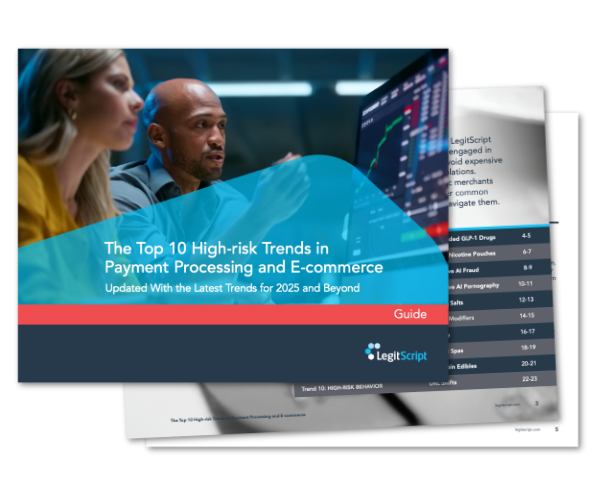
The Top 10 High-risk Trends in Payment Processing and E-commerce
In this updated guide, LegitScript shares new high-risk trends that companies should be aware of to avoid fines and brand damage.
24 pages
-
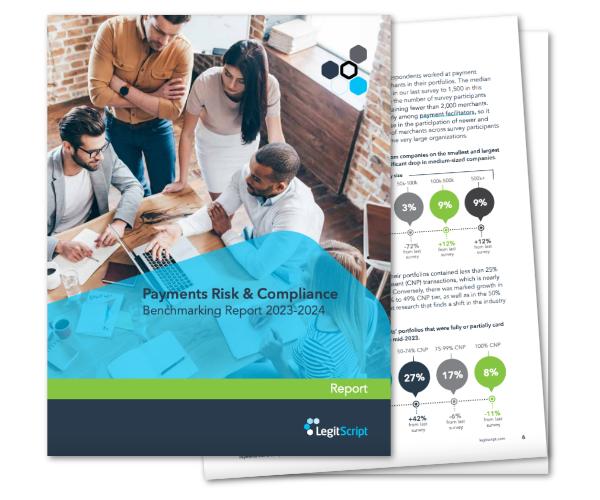
LegitScript Payments Risk & Compliance Benchmarking Report 2023-2024
LegitScript surveyed payments risk and compliance professionals about their recent challenges, impending threats, and opportunities. Hear what they had to say.
23 pages
-
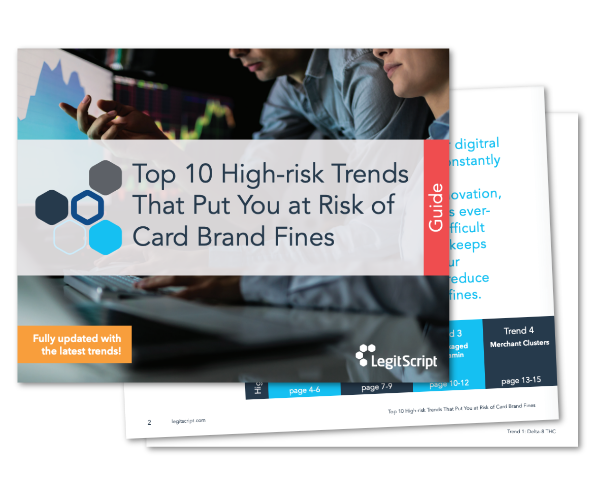
Top 10 High-risk Trends That Put You at Risk of Card Brand Fines
Learn about recent high-risk trends with card-not-present transactions that are likely to lead to expensive card brand fines.
36 pages
Webinars

On Demand
ENDS Regulatory Updates: What Payments and Platforms Need to Know About Changes to Vaping Laws
Only 48 e-cigarettes hold FDA authorization out of thousands on the market. Join LegitScript to unpack the flavor ban reversal, PMTA process, and PACT Act rules shaping ENDS compliance for payments companies and platforms.

On Demand
Fraud, Compliance, and the New Rules of Risk in Brazil and Latin America
Brazil and Latin America are not just grappling with fraud — they are at the epicenter of a global stress test exacerbated by AI-powered schemes that make merchants and sellers harder than ever to trust. In this webinar, we discuss the risks and regulatory challenges facing companies engaged in digital transactions in Brazil and LATAM. Sign up now.
-
On Demand
Trust Is Getting Harder to Prove: Rethinking Merchant Underwriting in the Age of AI
Leading payment service providers are rethinking onboarding and underwriting in a future undergirded by AI, moving beyond KYC to verify merchant intent, apply risk-based friction, and continuously defend their portfolios. Learn what durable trust models look like in the AI age.