
Retatrutide is not approved anywhere in the world, yet it is already sold online at scale. Keep reading to learn what retatrutide is, why its use is spreading, and what payment processors and online platforms need to consider to reduce their risk exposure.
Then learn more about how LegitScript helps payments companies and marketplaces vet compliant peptides merchants while removing problematic ones from their portfolios and platforms.
What Is Retatrutide?
Weight loss peptides are having their moment in the spotlight. Semaglutide, tirzepatide, and liraglutide are FDA-approved GLP-1 agonists for weight loss, and a new peptide is now vying for a place among them: retatrutide. Suppliers and wellness providers are eager to capitalize on the trend. However, retatrutide’s lack of approval and its growing black market mean hidden dangers for unsuspecting buyers and real risk for the payment processors that facilitate these sales.
Retatrutide is an investigational drug developed by Eli Lilly that activates the body’s receptors for glucose-dependent insulinotropic polypeptide (GIP), glucagon-like peptide-1 (GLP-1), and glucagon. What sets it apart from approved GLP-1 therapies is its action on three receptors rather than one or two.
Early results suggest retatrutide may lead the race among similar drugs. A review of randomized trials found 24.2% weight loss with retatrutide, compared with 17.8% for tirzepatide, 13.9% for semaglutide, and 5.8% for liraglutide. In May 2026, Lilly reported that participants on the highest dose in its first Phase 3 obesity trial lost an average of 28.3% of their body weight at 80 weeks.
An Unapproved Yet Widely Available Peptide
While retatrutide shows great promise, it is still an investigational medicine. It has not been approved by any regulatory body worldwide, and Lilly has stated that it plans to submit retatrutide for FDA review in 2027. Until then, the only legitimate source of the drug is Lilly’s clinical research. Retatrutide cannot be legally prescribed or sold, and the FDA has stated that it cannot be used in compounding under federal law.
This lack of approval has not stopped sales. Retatrutide’s results have generated viral buzz online, and consumers are turning to black market vendors and overseas suppliers to get their hands on the drug. In August 2026, Lilly filed six new lawsuits against a compounding pharmacy, an aesthetic medicine provider, and several peptide vendors that allegedly sold retatrutide under “research use only” marketing. Lilly has also flagged more than 14,000 websites, advertisements, social media posts, and product listings offering retatrutide in more than 100 countries.
LegitScript Has Been Tracking the Retatrutide Landscape
Even before interest in retatrutide became mainstream, LegitScript has been tracking unauthorized sales from bad actors. Since 2024, LegitScript’s Merchant Monitoring services have reported more than 1,000 cases of elevated retatrutide-related risk to clients, involving medical spas, peptide vendors, pharmacies, and other merchants.
These products follow recognizable patterns. Sellers typically offer lyophilized (freeze-dried) powder in vials or injectable pens, often marketed as “Reta” or “GLP-3.” Many are labeled “for research purposes” or “not for human consumption,” a practice the FDA has specifically warned against.
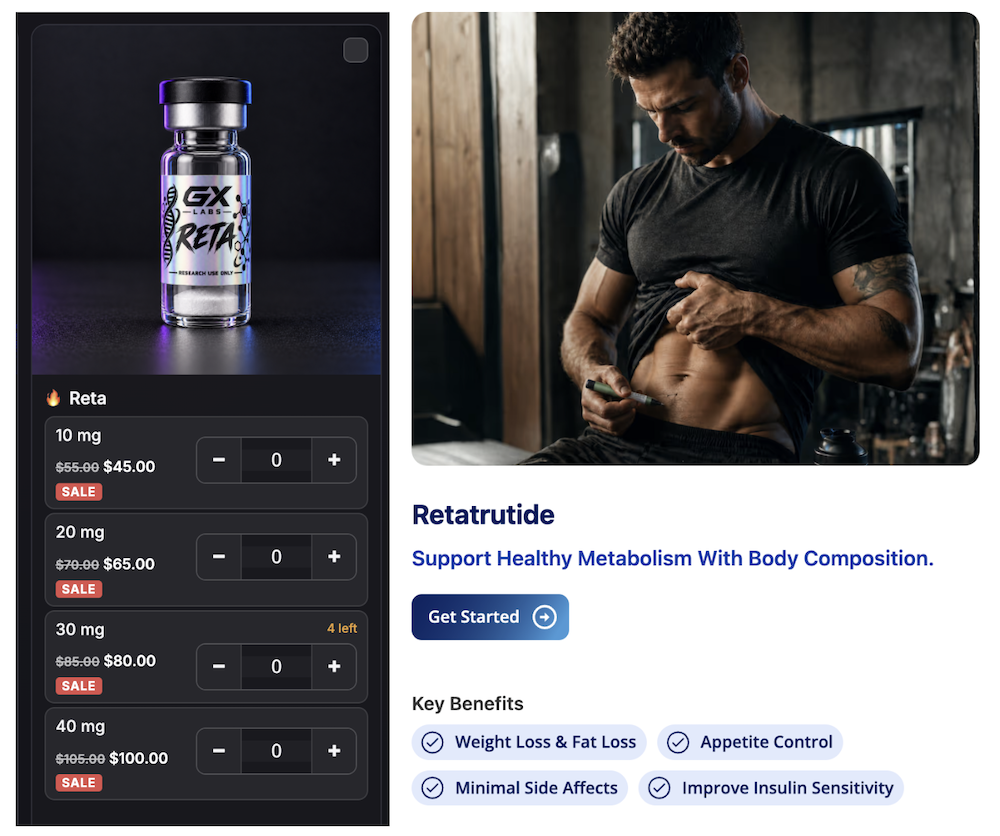
Retatrutide products marketed online as “Reta” (left) and offered through a weight loss provider.
While these products are said to contain retatrutide, Lilly’s clinical research is the only legitimate channel for the drug. Any product obtained elsewhere could be counterfeit, mislabeled, non-sterile, or contaminated, and buyers have no reliable way to know what they are injecting.
From Consumer Harm to Portfolio Risk
Black market retatrutide has already been potentially linked to two deaths in reports submitted to the FDA, although it cannot be confirmed that the products involved actually contained retatrutide, since they were obtained through illicit channels.
Consumer harm is not the only risk. Like other unapproved drugs, retatrutide can result in card brand scrutiny and fines for payment processors caught facilitating its sale, including penalties under Visa’s Integrity Risk Program (VIRP) and Mastercard’s Business Risk Assessment and Mitigation (BRAM) program. Because many sellers present themselves as wellness clinics or research suppliers, these merchants can be difficult to identify without specialized monitoring.
Separate the Compliant Peptides Merchants from the Problematic
LegitScript helps you accept compliant peptide merchants while keeping the problematic ones out of your portfolio or off your platform.
Our Healthcare Merchant Certification provides a recognized stamp of approval for businesses that facilitate the sale of pharmaceuticals, including approved peptide drugs. Our certification process helps online pharmacies and other healthcare merchants meet the required compliance and best practice standards, and enables them to promote their business and process payments.
LegitScript’s Merchant Risk Solutions combines advanced technology with expert analysts to quickly identify merchants offering retatrutide and other unapproved drugs during underwriting and within client portfolios. We report these merchants to our clients so they can take action before the fines hit. For a deeper look at peptide risk, download our Understanding Peptides guide.
To learn more about how we can help you reduce risk while growing your business, contact us.


![ProEXR File Description
=Attributes=
applied_color_corrections (int): 0
cameraAperture (float): 36
cameraFNumber (float): 1.22842
cameraFarClip (float): 1e+030
cameraFarRange (float): 1000
cameraFocalLength (float): 48.4507
cameraFov (float): 39.0481
cameraNearClip (float): 0
cameraNearRange (float): 0
cameraProjection (int): 0
cameraTargetDistance (float): 106.379
cameraTransform (m44f): [{-0.897242, -0.410816, -0.161825, 47.9122}, {-0.44154, 0.83481, 0.32884, 377.78}, {1.21072e-008, 0.366501, -0.930418, 39.1904}, {0, 0, 0, 1}]
channels (chlist)
compression (compression): Zip
dataWindow (box2i): [0, 0, 5999, 2999]
displayWindow (box2i): [0, 0, 5999, 2999]
lineOrder (lineOrder): Increasing Y
name (string): ""
pixelAspectRatio (float): 1
screenWindowCenter (v2f): [0, 0]
screenWindowWidth (float): 1
type (string): "scanlineimage"
vfb2_layers_json (string): "{"Version":1,"class":"root","properties":{"version":1,"name":"","enable":true,"expand":false,"expandable":true},"sub-layers":[{"class":"chaos.displayCorrection","properties":{"version":1,"name":"Display Correction","enable":true,"expand":true,"expandable":true,"profile":1,"exposure":0.0,"save_rgb_primitives":false,"icc_file":"","icc_profile_data":null,"icc_rendintent":0,"blkptconv":false,"ocio_file":"","ocio_colorspace":0,"ocio_displaydevice":0,"ocio_viewtransform":0,"ocio_saveinimage":false},"sub-layers":[{"class":"chaos.ref.sourcefolder","properties":{"version":1,"name":"Source: LightMix","enable":true,"expand":false,"expandable":false,"blend_mode":0,"opacity":1.0,"show_preview":true,"src_type":2},"sub-layers":[{"class":"chaos.ref.lightmix","properties":{"version":1,"name":"LightMix","enable":true,"expand":false,"expandable":true,"lmElem_on_All":true,"lmElem_mult_All":1.0,"lmElem_color_All":[1.0,1.0,1.0],"lmElem_on_VRayLight DOME":true,"lmElem_mult_VRayLight DOME":1.0,"lmElem_color_VRayLight DOME":[1.0,1.0,1.0],"VRayLight DOME":-1,"lmElem_on_VRayLight02":true,"lmElem_mult_VRayLight02":1.0,"lmElem_color_VRayLight02":[1.0,1.0,1.0],"VRayLight02":-1,"lmElem_on_VRayLight04":true,"lmElem_mult_VRayLight04":1.0,"lmElem_color_VRayLight04":[1.0,1.0,1.0],"VRayLight04":-1,"lmElem_on_Environment":true,"lmElem_mult_Environment":1.0,"lmElem_color_Environment":[1.0,1.0,1.0],"lmElem_on_Self Illumination":true,"lmElem_mult_Self Illumination":1.0,"lmElem_color_Self Illumination":[1.0,1.0,1.0],"lmElem_on_Rest":true,"lmElem_mult_Rest":1.0,"lmElem_color_Rest":[1.0,1.0,1.0]},"sub-layers":[]},{"class":"chaos.ref.composite","properties":{"version":1,"name":"Composite","enable":false,"expand":false,"expandable":true,"blend_mode":0,"opacity":1.0,"show_preview":true},"sub-layers":[]}]},{"class":"chaos.pe.denoiser","properties":{"version":1,"name":"Denoiser","enable":true,"expand":false,"expandable":true,"blend_mode":0,"opacity":1.0,"active":true,"preset":2,"strength":1.0,"radius":10.0,"hwAccelerate":true,"denoiser_mode":1},"sub-layers":[]},{"class":"chaos.pe.sharpen.blur","properties":{"version":1,"name":"Sharpen/Blur","enable":false,"expand":false,"expandable":true,"blend_mode":0,"opacity":1.0,"sharpen_blur_compute":false,"sharpen_amount":1.0,"sharpen_radius":0.5,"blur_radius":1.330000042915},"sub-layers":[]},{"class":"chaos.pe.lensfx","properties":{"version":1,"name":"Lens Effects","enable":false,"expand":false,"expandable":true,"blend_mode":2,"opacity":1.0,"glare_on":false,"glare_size":30.0,"glare_weight":1.0,"bloom_weight":0.40000000596,"glare_threshold":1.0,"filter_rotation":0.0,"saturation":1.0,"hardware_accelerated":true,"cold_warm":false,"interactive":true,"save_glare":true,"bake_glare_weight":false,"create_effects_result_channel":false,"enable_blades":true,"sides":6,"blades_rotation":15.0,"streak_blur":0.20000000298,"use_grating":false,"grating_density":50.0,"grating_length":10.0,"grating_zoom":5.0,"grating_slope":0.0,"grating_strength":1.0,"use_occlusion":false,"occlusion_symmetric":true,"occlusion_percent":20.0,"occlusion_rotation":0.0,"occlusion_arc":100.0,"use_scratch":false,"scr_symmetric":true,"scr_pattern":0,"scr_multiglare_count":1,"scr_density":50.0,"scr_length":50.0,"scr_slope_variance":0.0,"scr_width_variance":0.0,"scr_seed":0,"scr_zoom":2.0,"scr_rotation":0.0,"scr_strength":1.0,"use_dust":false,"dust_pattern":0,"dust_density":50.0,"dust_radius_variance":0.0,"dust_jitter":0.0,"dust_zoom":2.0,"dust_rotation":0.0,"dust_strength":1.0,"glare_use_obstacle_image":false,"glare_obstacle_image_path":"","obst_image_zoom":1.0,"obst_image_rotation":0.0,"obst_image_strength":1.0,"use_filter_image":false,"glare_image_path":"","camera_type":0,"stereo_mode":0},"sub-layers":[]},{"class":"chaos.cc.constant","properties":{"version":1,"name":"Constant","enable":false,"expand":false,"expandable":true,"blend_mode":0,"opacity":1.0,"show_preview":true,"multiplier":1.0,"color":[1.0,1.0,1.0]},"sub-layers":[]},{"class":"chaos.cc.curves","properties":{"version":1,"name":"Curves","enable":false,"expand":false,"expandable":true,"blend_mode":0,"opacity":1.0,"show_preview":true,"curve_graph":{"version":1,"Master":{"points":[{"point_type":2,"point_center":[0.0,0.0],"left_vector":[-0.282842725515,-0.282842725515],"right_vector":[0.098449602723,0.098449602723]},{"point_type":3,"point_center":[0.295348793268,0.169256746768],"left_vector":[-0.098449610173,-0.097978599369],"right_vector":[0.154909551143,0.15416842699]},{"point_type":3,"point_center":[0.760077416896,0.804729640483],"left_vector":[-0.154909551143,-0.172791361808],"right_vector":[0.079974196851,0.089205920696]},{"point_type":2,"point_center":[1.0,1.0],"left_vector":[-0.079974196851,-0.079974196851],"right_vector":[0.282842725515,0.282842725515]}]}}},"sub-layers":[]},{"class":"chaos.cc.exposure","properties":{"version":1,"name":"Exposure","enable":false,"expand":false,"expandable":true,"blend_mode":0,"opacity":1.0,"show_preview":true,"exposure":-0.212765961885,"hilight_burn":0.875886559486,"contrast":0.127659574151},"sub-layers":[]},{"class":"chaos.cc.whiteBalance","properties":{"version":1,"name":"White Balance","enable":false,"expand":false,"expandable":true,"blend_mode":0,"opacity":1.0,"show_preview":true,"temp":4967.56787109375,"tint":0.124324329197,"color_tint":[1.0,1.0,1.0]},"sub-layers":[]}]},{"class":"chaos.overlay.stamp","properties":{"version":1,"name":"Stamp","enable":false,"expand":false,"expandable":true,"stamp_horiz_align":1,"stamp_vert_align":32,"stamp_color":[1.0,1.0,1.0],"stamp_font":{"version":1,"point_size":10,"family":0,"style":0,"weight":0,"face":"Arial"},"stamp_string":{"version":1,"raw_string":"V-Ray %vrayversion | file: %filename | frame: %frame | primitives: %primitives | render time: %rendertime","final_string":"V-Ray 6.00.20 | file: production line glass bottles blue.max | frame: 00000 | primitives: 22233693 | render time: 0h 1m 8.6s"}},"sub-layers":[]}]}"
vrayChannelInfo (string): "{"VRayRenderID":{"alias":114,"index":2,"flags":5,"type":4},"worldPositions":{"alias":143,"index":14,"flags":8292,"type":5},"VRayLightMix":{"alias":178,"index":3,"flags":198409,"type":2},"refractionFilter":{"alias":120,"index":18,"flags":8228,"type":2},"VRayLight DOME":{"alias":163,"index":4,"flags":8200,"type":2},"worldNormals":{"alias":145,"index":15,"flags":36,"type":5},"VRayDenoiser":{"alias":144,"index":11,"flags":1025,"type":2},"noiseLevel":{"alias":142,"index":12,"flags":16420,"type":1},"effectsResult":{"alias":153,"index":19,"flags":16517,"type":2},"Alpha":{"alias":125,"index":1,"flags":16389,"type":2},"RGB color":{"alias":126,"index":0,"flags":16385,"type":2},"Environment":{"alias":163,"index":7,"flags":8200,"type":2},"VRayLight04":{"alias":163,"index":5,"flags":8200,"type":2},"VRayLight02":{"alias":163,"index":6,"flags":8200,"type":2},"diffuseFilter":{"alias":101,"index":16,"flags":8228,"type":2},"defocusAmount":{"alias":146,"index":13,"flags":36,"type":1},"Self Illumination":{"alias":163,"index":8,"flags":8200,"type":2},"VRaySpecular":{"alias":106,"index":10,"flags":8,"type":2},"reflectionFilter":{"alias":118,"index":17,"flags":8228,"type":2},"VRayRefraction":{"alias":103,"index":9,"flags":8,"type":2}}"
vrayInfo/camera (string): "VRayPhysicalCamera004"
vrayInfo/cleanupTimeID (string): "0.0s"
vrayInfo/computername (string): "ef"
vrayInfo/cpu (string): "INTEL/Model:15,Family:6,Stepping:2,Cache:0"
vrayInfo/date (string): "9/25/2025"
vrayInfo/elapsedtime (string): "12h 18m 40.1s"
vrayInfo/engine (string): "CPU"
vrayInfo/filename (string): "production line glass bottles blue.max"
vrayInfo/frame (string): "00000"
vrayInfo/frameTimeID (string): "0.0s"
vrayInfo/freeMemCPU (string): "22.09 (GiB)"
vrayInfo/h (string): "0"
vrayInfo/lightcacheTimeID (string): "0.0s"
vrayInfo/mhz (string): "0MHz"
vrayInfo/noiseThreshold (string): "0.001000"
vrayInfo/numPasses (string): "0"
vrayInfo/numSubdivs (string): "0.00"
vrayInfo/os (string): "Win10"
vrayInfo/peakMemory (string): "6820.96 MiB"
vrayInfo/primitives (string): "22233693"
vrayInfo/ram (string): "65456MB"
vrayInfo/rendertime (string): "12h 18m 39.1s"
vrayInfo/sequenceTimeID (string): "0.0s"
vrayInfo/threadPrio (string): "lowest"
vrayInfo/threads (string): "16"
vrayInfo/time (string): "02:59:50"
vrayInfo/totalCPUMem (string): "63.92 (GiB)"
vrayInfo/usedMemCPU (string): "20.56 (GiB)"
vrayInfo/vmem (string): "134217728MB"
vrayInfo/vraycore (string): "6.00.20"
vrayInfo/vrayversion (string): "Internal V-Ray version 6.00.20"
vrayInfo/w (string): "0"
=Channels=
A (half)
B (half)
Environment.B (half)
Environment.G (half)
Environment.R (half)
G (half)
R (half)
Self Illumination.B (half)
Self Illumination.G (half)
Self Illumination.R (half)
VRayDenoiser.B (half)
VRayDenoiser.G (half)
VRayDenoiser.R (half)
VRayLight DOME.B (half)
VRayLight DOME.G (half)
VRayLight DOME.R (half)
VRayLight02.B (half)
VRayLight02.G (half)
VRayLight02.R (half)
VRayLight04.B (half)
VRayLight04.G (half)
VRayLight04.R (half)
VRayRefraction.B (half)
VRayRefraction.G (half)
VRayRefraction.R (half)
VRayRenderID (uint)
VRaySpecular.B (half)
VRaySpecular.G (half)
VRaySpecular.R (half)
defocusAmount (half)
diffuseFilter.B (half)
diffuseFilter.G (half)
diffuseFilter.R (half)
effectsResult.B (half)
effectsResult.G (half)
effectsResult.R (half)
noiseLevel (half)
reflectionFilter.B (half)
reflectionFilter.G (half)
reflectionFilter.R (half)
refractionFilter.B (half)
refractionFilter.G (half)
refractionFilter.R (half)
worldNormals.X (half)
worldNormals.Y (half)
worldNormals.Z (half)
worldPositions.X (float)
worldPositions.Y (float)
worldPositions.Z (float)](https://www.legitscript.com/wp-content/uploads/bb-plugin/cache/peptides-vials-iStock-2237287346-300x158-panorama-4da87aac3696ac81e10553b2a9c8a36f-7spvi24g3u8y.jpg "peptides-vials-iStock-2237287346")