
Discovering violative merchant activity is only one part of effective risk management. After detecting a merchant’s violative behavior, risk and compliance teams must prove it, act on it, and later defend that action to auditors, upstream partners, card networks, and sometimes even the merchants themselves.
The better you can document a serious violation and your response to it, the less exposure your business carries. Keep reading to learn more about best practices for documenting violative merchant activity.

July 23, 2026 | by LegitScript Folks
Why Documentation Is an Essential Component of Merchant Risk Management
Collecting evidence of severe violations at the time a merchant is flagged serves multiple purposes and is part of a responsible risk management process. This evidence helps to:
- Satisfy upstream oversight. Many payment service providers are required to provide documentation of BRAM- and VIRP-level merchant violations to the sponsor banks and to provide internal audit trails.
- Dispute merchant denials. After being flagged, some merchants may change their websites and deny the violation took place; documented evidence helps to contradict this type of subterfuge.
- Demonstrate value. By documenting merchant violations, underwriting and risk teams can more concretely demonstrate their value to the wider organization by showing savings in potential BRAM and VIRP fines.
What Good Evidence Looks Like
Resolving a violation efficiently, and defending that resolution later, comes down to three things:
- Specificity. The evidence should point to the exact product, service, or page that triggered the finding, not a general description of the merchant's business.
- Timing. The evidence should reflect the moment of detection, not a later snapshot that a merchant could argue no longer applies.
- Accessibility. Your team, your acquiring partners, and your auditors should all be able to review the same evidence without extra steps or handoffs.
LegitScript Merchant Monitoring is built around this standard. When our analysts identify a BRAM- or VIRP-level violation, the report includes a detailed explanation of the finding alongside screenshots of the specific page that proves it. That means objective, audit-ready visual evidence attached to every finding, with no change to how your team already works.
What LegitScript’s Documentation Capabilities Mean for Your Team
In the LegitScript client portal, screenshots for egregious violations appear directly on the merchant detail page. Your team can review them as thumbnails, open a scrollable carousel for a closer look, and download individual images or the full set as a zip file. For merchants in sensitive categories, thumbnails stay hidden until someone on your team chooses to open them, so no one encounters graphic content unintentionally.
If your organization receives merchant data through the LegitScript API or webhooks, that same evidence arrives as secure links directly on the merchant object. Your underwriters and risk analysts never have to leave their internal systems to see exactly what triggered the flag.
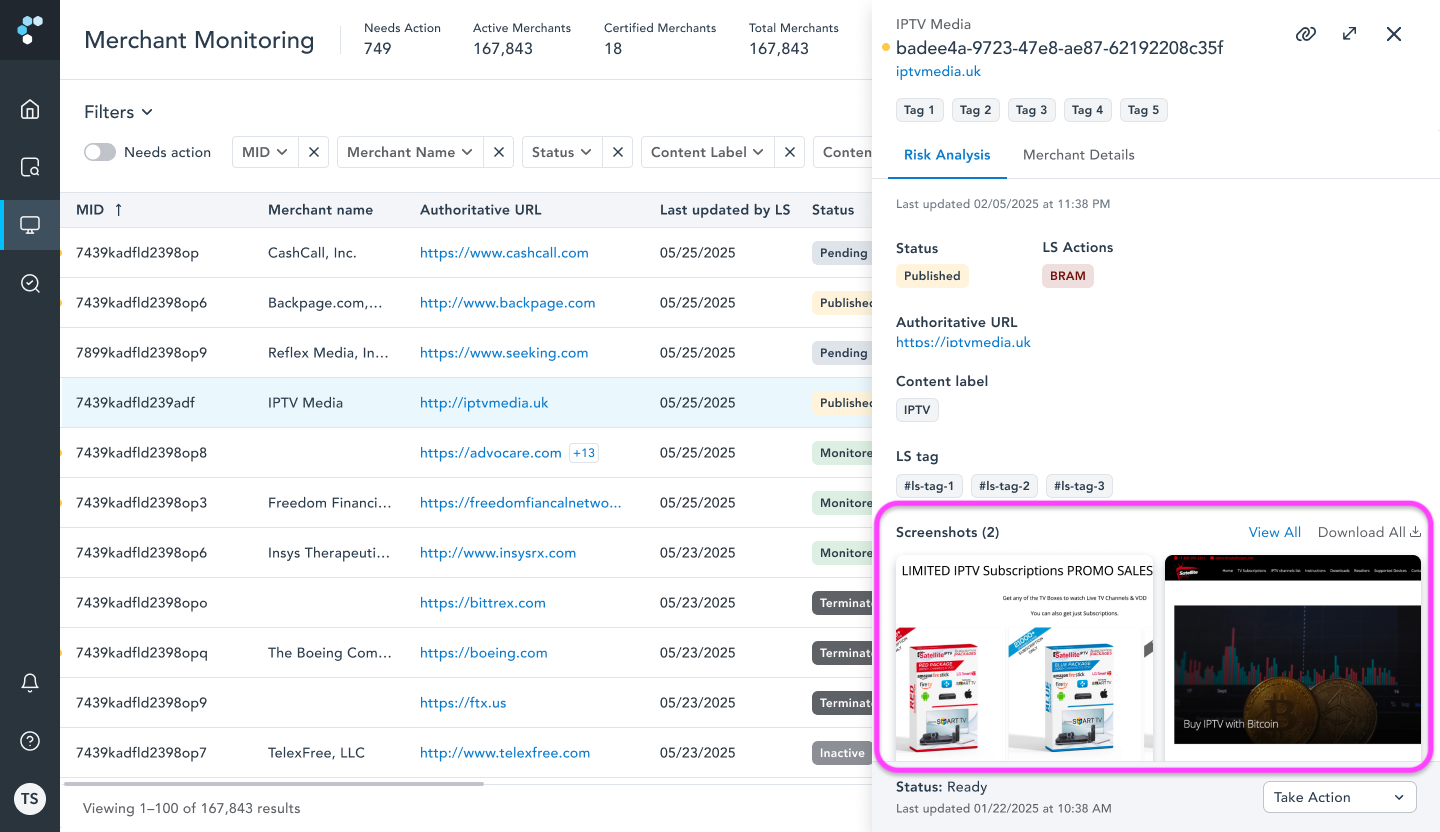
LegitScript's screenshot functionality is built into the portal on the merchant's detail page, making screen captures easy to find, view, and share.
How to Put This Into Practice
Visual evidence only helps if it changes how your team responds. A few practices worth building into your workflow:
Move on documented violations immediately. When a finding includes clear visual proof, there is little reason to wait for additional confirmation before starting remediation with the merchant or escalating internally.
Use the evidence in merchant conversations. A screenshot removes ambiguity from a compliance conversation. Merchants are far less likely to dispute a finding when they are looking at the exact page that caused it.
Keep evidence with your audit trail. Card network audits and scheme reviews move faster when you are able to provide the proof of a serious violation.
The Bigger Picture
Documenting egregious merchant violations is an ongoing responsibility that shapes whether your organization keeps the trust of card networks, regulators, and the customers who rely on your platform. Having a built-in process that collects and documents evidence seamlessly makes that responsibility manageable at scale.
LegitScript exists to make the internet and payments ecosystem safer and more transparent, one well-documented finding at a time. If you have questions about how visual evidence fits into your existing Merchant Monitoring workflow, reach out to us — we would be glad to walk your team through it.